
| Fitting Type | Available as | Use |
|---|---|---|
| Elbow (45°, 90°) | Threaded / Socket Weld | Changes direction |
| Tee | Both | Branching lines |
| Coupling | Both | Connects two pipes |
| Shapes Available | Mostly round | Round, square, rectangular |
| Union | Threaded | Allows easy disconnection |
| Cross | Both | Four-way junction |
| Cap | Both | Closes pipe ends |
| Plug | Threaded | Seals pipe openings |
| Bushing | Threaded | Reduces pipe size |
| Reducer | Socket Weld | Changes diameter of pipe |
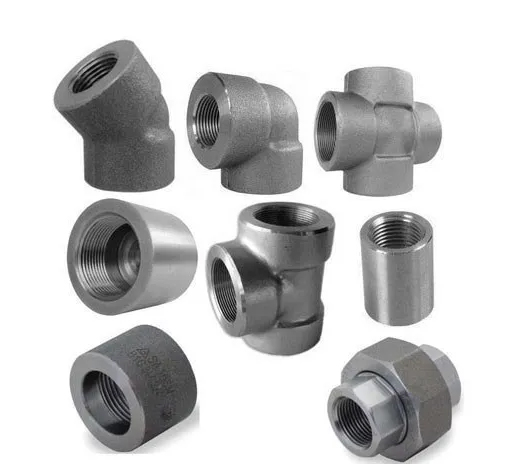
Forged fittings are manufactured by forging steel, which increases strength and reliability. They are available in:
Threaded (Screwed) Ends
Threads conform to NPT (National Pipe Thread) standards. No welding is required—simply screwed into place.
Socket Weld Ends
Pipes are inserted into a recessed area and welded around the joint—ideal for high-leakage integrity.
Alloy Steel
ASTM A182 F1/F5/F9/F11/F22/F91 etc.
Common Types of Forged Fittings
Pressure Ratings
Forged fittings are classified by pressure class:
Materials Available
Standards & Specifications
| Standard | Description |
|---|---|
| ASME B16.11 | Forged fittings (socket weld & threaded) |
| ASTM A105 | Carbon steel forged fittings |
| ASTM A182 | Forged stainless/alloy steel fittings |
| BS 3799 | Forged fittings dimensions & tolerances |
Applications
| Industry | Use |
|---|---|
| Oil & Gas | High-pressure pipelines |
| Petrochemical | Flammable fluid systems |
| Power Plants | Steam & water lines |
| Marine | Engine room systems |
| Hydraulic & Pneumatic | Control systems |